Moving an advanced metal component from design into active flight or field service is one of the most rewarding milestones in modern engineering. Sourcing precision parts for extreme environments requires absolute confidence in your production partner, especially when you are searching for a qualified manufacturing team near you to deliver mission-critical parts on schedule.
At Additive Manufacturing & Engineering, Inc., we understand that selecting a serial production supplier goes far beyond comparing basic line-item estimates. Laser powder bed fusion relies on strict material controls, stable machine parameters, and thorough process validation.
Whether your program requires an advanced metal 3D printing service for space exploration, defense platforms, or energy infrastructure, using a proven qualification framework protects your schedule and prevents costly assembly failures.
Production Readiness: Quick Evaluation Checklist for Engineers
Before releasing production purchase orders, design teams and procurement leads can quickly evaluate supplier readiness against these four critical benchmarks:
- Powder chemistry verification: Require documented certificates of analysis, strict virgin-to-reclaim ratios, and regular interstitial testing for oxygen and moisture pickup.
- True usable build capacity: Confirm your geometries fit inside the machine’s uniform laminar gas flow zone, not just the outer mechanical edges of the build plate.
- Tolerance and finishing integration: Plan for baseline as-printed tolerances around ±0.005 in, paired with integrated CNC machining on precision sealing faces and bearing bores.
- Serial quality governance: Partner with suppliers that provide complete build telemetry, destructive coupon testing, and full lot traceability for every production run.
Core Evaluation Pillars for Metal LPBF Production
Laser powder bed fusion fuses fine metal powder layer by layer using a high-precision laser beam. Because the internal metallurgy and physical properties form simultaneously during the build, evaluating a supplier requires auditing raw inputs, chamber stability, and post-processing controls.
Certified Materials and Powder Management
A printed component is only as reliable as the powder going into the recoater. High-integrity metal additive manufacturing relies on spherical, clean gas-atomized powders with tightly controlled particle size distributions, typically between 15 and 45 microns.
When auditing prospective suppliers, review their feedstock management protocols:
- Virgin-to-recycled ratios: Every time powder is recovered and exposed to heat, it can pick up ambient oxygen and surface oxides. Suppliers must define clear reuse thresholds to maintain uniform material properties.
- Storage and humidity control: Reactive alloys and high-temperature powders require storage in climate-controlled environments using sealed containers with inert gas blankets. The testing methods outlined by the ASTM International Committee F42 on Additive Manufacturing Technologies provide the industry baseline for powder characterization.
- Dedicated material handling: Cross-contamination degrades mechanical performance. Facilities running propulsion and heat-shielding alloys like Inconel 718 or high-conductivity alloys like GRCop-42 must maintain dedicated sieving stations and separate material loops.
Rigorous Traceability Across the Supply Chain
Aerospace, space launch, and defense systems demand complete documentation. Reliable metal powder traceability for additive manufacturing tracks the material from virgin raw ingot to the final serial plate on the machine platform.
A qualified vendor must provide mill certification sheets, sieve analysis records, and complete machine sensor telemetry. These build logs track oxygen levels, laser power, chamber pressure, and gas flow velocity across every hour of the run. For flight-critical hardware, your supplier must also supply pyrometry logs and certified run charts for stress-relief cycles and Hot Isostatic Pressing runs.
As-Built Tolerances and Precision Machining
LPBF creates intricate internal cooling passages and complex thin walls, but the process has natural physical boundaries:
- As-printed dimensional control: Typical as-built tolerances range from ±0.004 to ±0.008 in, depending on part geometry, build angle, and wall thickness.
- Thermal stress mitigation: Rapid heating and cooling cycles create internal residual stresses. Qualified suppliers run build simulation software before starting the machine to predict distortion, optimize support structures, and eliminate part recoater blade interference.
- Secondary CNC machining: When critical mating surfaces, tight bearing bores, or threaded holes demand tolerances within ±0.0005 in, your supplier must offer precision multi-axis CNC finishing referenced directly from defined build datums.
Chamber Volume and Thermal Stability
Build size involves more than the listed outer volume dimensions of a machine brochure. The usable production envelope depends on gas flow velocity across the bed, platform thermal stability, and beam focus consistency.
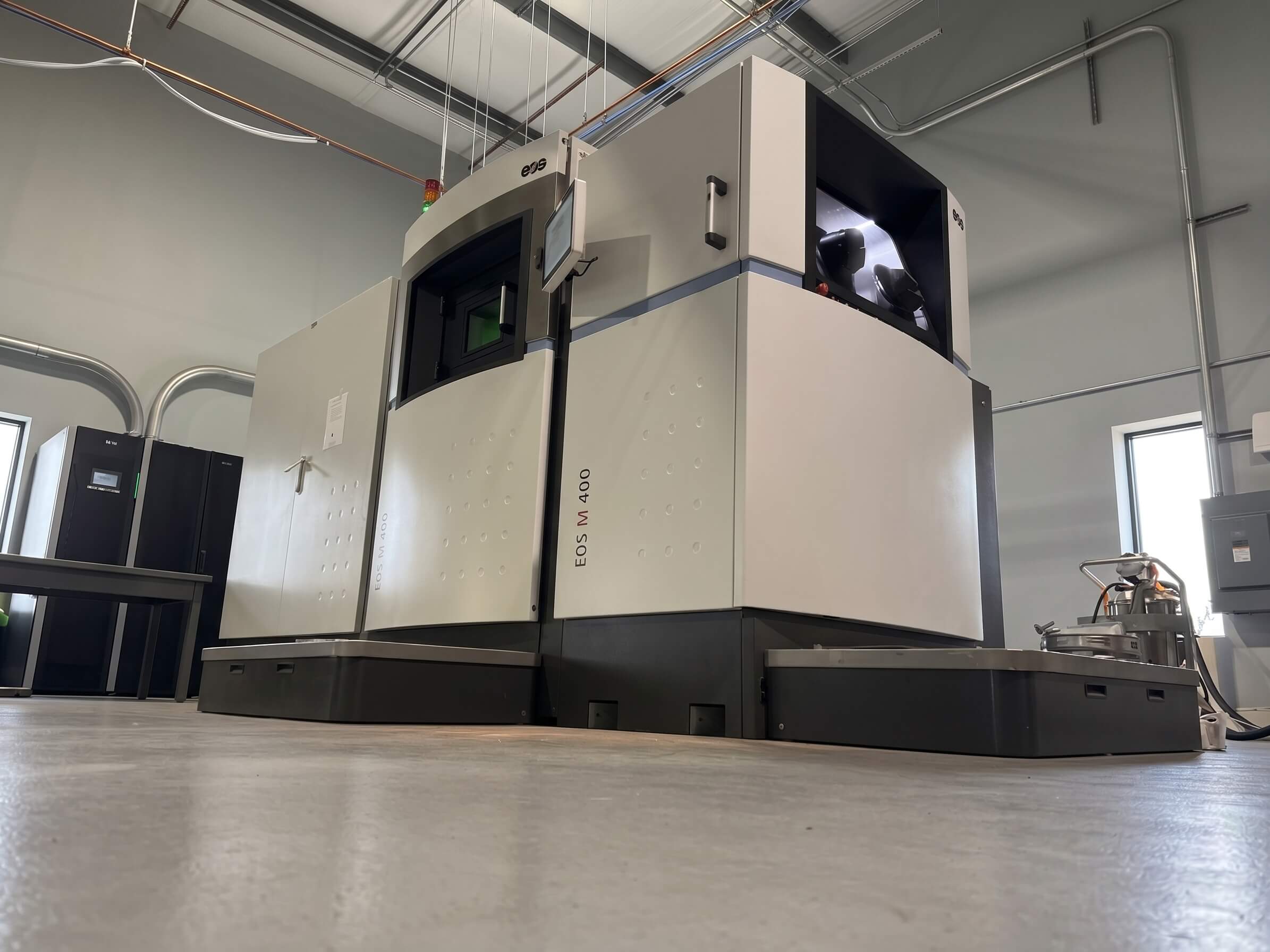
Production platforms like the EOS M 400 provide a generous 400 mm cubic envelope. Within that chamber, a steady laminar argon flow sweeps soot and laser condensate away from the melt path. If gas flow fluctuates, laser scattering can introduce micro-porosity and inconsistent density into the outer sections of your build.
Regional Advanced Manufacturing and Proven Defense Reliability
Precision engineering succeeds when there is direct collaboration and open technical communication. Tier-1 aerospace contractors and defense research teams frequently rely on our team for metal 3D printing Huntsville AL, benefiting from production facilities configured for extreme-environment hardware.
Operating within an established regional technology hub makes it straightforward for engineering teams to conduct on-site audits, review non-destructive inspection results, and transition complex prototypes into certified production. Direct collaboration between design teams and manufacturing engineers shortens turnaround times and resolves manufacturing issues before production begins.
Strategic Manufacturing Decisions: When to Deploy LPBF
Understanding where additive technology delivers the highest return ensures efficient use of your production budget. Strategic adoption of additive manufacturing for metals provides distinct advantages across several common scenarios:
- Mass reduction: Redesigning bulky solid components into lightweight internal lattices or organic structural ribs cuts overall weight while maintaining required structural stiffness.
- Part consolidation: Unifying multi-piece welded or brazed assemblies into a single component removes leak points, lowers part counts, and simplifies procurement.
- High-heat fluid systems: Combining nickel superalloys like Inconel 718 with high-conductivity alloys like GRCop-42 allows propulsion teams to integrate regenerative cooling channels directly into combustion liners and heat exchangers.
When components have simple external shapes without internal passages or strict weight restrictions, conventional CNC machining from standard billet or bar stock is often the faster, more economical choice. A dependable manufacturing partner will always tell you when traditional methods fit your design better.
LPBF Supplier Qualification Checklist
Use this checklist during supplier audits to verify that a manufacturing partner meets production standards:
- Material controls: Verified sieve analysis, documented moisture monitoring, and strict virgin-to-reclaim powder policies that conform to ASTM standards.
- Process telemetry: Complete digital logging of chamber oxygen parts-per-million, laser output stability, and recoater travel data for every build.
- Thermal treatment records: Validated vacuum stress relief, solution heat treatment, and Hot Isostatic Pressing runs to achieve relative part densities of 99.7 percent or higher.
- Dimensional inspection: Calibrated coordinate measuring machine reports and 3D optical scanning comparing finished surfaces against original CAD models.
- Quality and security systems: Active quality registrations and defense compliance frameworks appropriate for mission-critical hardware, including ITAR compliance.
From Complex Designs to Production-Ready Components
Qualifying a manufacturing supplier requires looking past equipment brochures to evaluate the material tracking, process control, and engineering experience behind the machines. Taking the time to verify these systems early ensures your components arrive on dimension, on budget, and ready for critical service.
If your team is preparing a complex design for production, request a manufacturing review with our engineering team today. We will evaluate your 3D CAD models, review material requirements, check feature tolerances, and help you transition your design into reliable, flight-ready hardware.