Advanced manufacturing relies on cutting-edge machinery, but specialized metallurgical talent turns that machinery into flight-ready hardware. For aerospace primes, defense contractors, and industrial teams searching for powder metallurgy 3D printing, Huntsville, Alabama offers an unmatched intersection of technical education, applied research, and operational industrial capacity.
At Additive Manufacturing & Engineering, Inc. (AME), we operate at the center of this ecosystem. Headquartered at 128 Hall Bryant Circle in Huntsville, our team leverages over 35 years of combined additive manufacturing (AM) experience to manufacture high-consequence metal components using laser powder bed fusion (LPBF).
Operating advanced additive hardware requires deep intuition regarding thermal behavior, powder handling, and crystal structures. That is why the regional talent pipeline—spanning local universities, technical colleges, and NASA’s Marshall Space Flight Center—serves as the backbone of Huntsville’s metal AM industry.
 Watch
Precision Metal AM: Hardware Meets Metallurgy
Industrial metal 3D printing is not a push-button commodity. Turning reactive or refractory metal powders into structural, high-density parts requires precise control over laser parameters, gas flow dynamics, build orientation, support generation, and thermal dissipation.
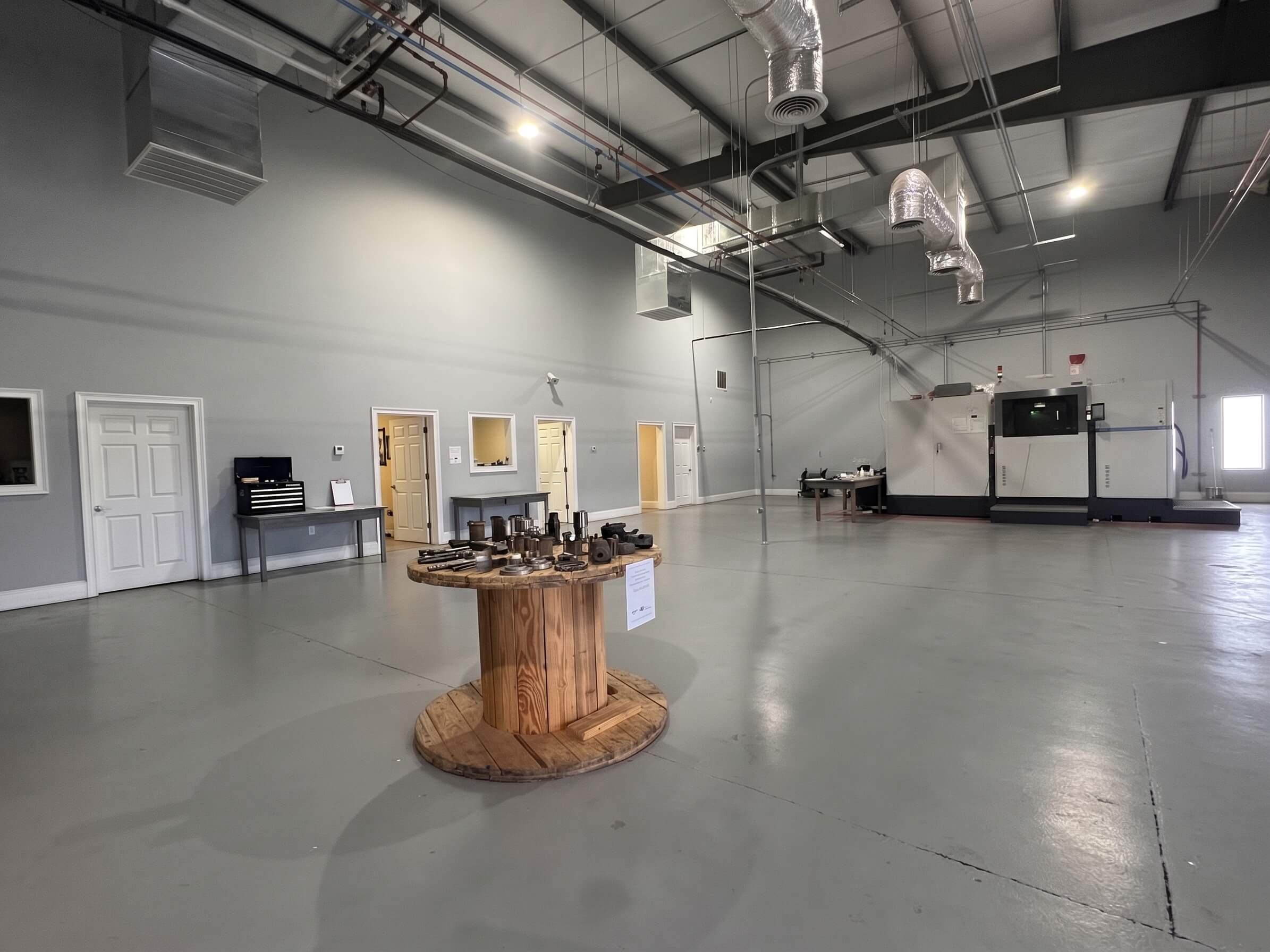
AME delivers specialized LPBF capabilities using an EOS M 400 platform featuring:
- Generous build envelope: Accommodates geometries up to 400 mm × 400 mm × 400 mm.
- Specialized high-performance alloys: Production capability centered on high-conductivity copper alloys (GRCop-42) and nickel-based superalloys (INCONEL 718), with additional metals evaluated based on program requirements.
- DfAM preparation: While AME does not design parts from scratch, we collaborate directly with client engineering teams to review, orient, support, and prepare customer-supplied CAD models (accepting STEP, STL, and OBJ formats) for reliable builds.
Printing components for extreme thermal and structural environments—such as rocket propulsion systems and high-pressure manifolds—demands an intimate understanding of how these alloys react under intense thermal cycles.
The Materials Challenge: Why GRCop-42 and Inconel Demand Real Talent
The true differentiator in metal additive manufacturing is materials expertise. Hardware parameters must adapt to the physics of each specific alloy.
1. GRCop-42 (Copper-Chromium-Niobium)
Developed by NASA for regenerative cooling channels in liquid rocket engines, GRCop-42 retains exceptional structural strength at temperatures exceeding 1,400°F (760°C) while maintaining superior thermal conductivity.
Printing GRCop-42 is notoriously difficult due to copper’s natural thermal conductivity and high reflectivity at standard laser wavelengths. Operating within tight process windows is critical to avoid lack-of-fusion voids. AME’s documented work with NASA’s Marshall Space Flight Center on initiatives like the LLAMA (Long-Life Additive Manufacturing Assembly) project demonstrates the hands-on process parameter mastery required to print complex thrust-chamber hardware.
2. INCONEL 718
Widely utilized across aerospace, turbomachinery, and defense, INCONEL 718 resists oxidation, corrosion, and high mechanical stress from cryogenic to elevated temperatures.
However, its rapid thermal contraction during printing makes parts susceptible to severe residual stress and micro-cracking if build parameters and supports are poorly managed. Translating digital slice data into a solid superalloy component requires engineers who understand phase transformations, heat treatment, and post-print stress relief.
How Huntsville’s Academic Pipeline Feeds Industrial AM
Huntsville’s engineering colleges supply the baseline scientific knowledge that makes advanced production at companies like AME possible:
- The University of Alabama in Huntsville (UAH): A premier aerospace and mechanical research university, UAH grounds students in thermodynamics, computational fluid dynamics, materials science, and additive research, feeding high-caliber engineers directly into local industry.
- Alabama A&M University: Through targeted programs in engineering, advanced materials research, and manufacturing sciences, Alabama A&M expands the regional knowledge base in material characterization and testing.
- Calhoun Community College: Calhoun bridges the gap between digital models and machine execution. Through its Additive Manufacturing Design program and the Alabama Center for Additive Manufacturing Excellence (ACAME), Calhoun trains the skilled technicians who manage machine setup, powder recovery, post-processing, and hardware maintenance.
This multi-tiered educational environment ensures Huntsville companies have direct access to professionals who understand both the theoretical physics of metallurgy and the practical requirements of running an industrial production floor.
Partner With Huntsville’s Metal Additive Specialists
Whether you are developing prototype propulsion components or producing low-rate initial production (LRIP) runs in extreme-environment alloys, your parts demand proven process parameters and deep metallurgical experience.
Have a complex component ready for production? Request a build quote today or send your STEP/STL files directly to info@addmaneng.com to evaluate print parameters, lead times, and material availability for your application.