IN718
Inconel 718
A nickel superalloy that keeps its strength and creep resistance where aluminium and steel give up. The default for turbine, manifold and structural hardware that runs hot.
Inconel 718 3D printingLaser powder bed fusion in Inconel 718 and GRCop-42 on the largest commercial metal platform in Alabama. One prototype or a pilot run, quoted by an engineer and shipped anywhere in the country.
AME is an industrial metal 3D printing company in Huntsville, Alabama. We run a single process, laser powder bed fusion, on an EOS M 400 with a 400 mm cube build envelope, and we run it on two alloys that propulsion and turbomachinery programs actually fly. Send a model and you get pricing, a build orientation and an honest read on whether the geometry will build.
A file goes in and a part comes out, but the part is only useful if the metal is sound, the dimensions hold and the paperwork travels with it. Our service covers the whole chain, with a person you can call at every step.
Industrial metal 3D printing means production class hardware: a 1 kilowatt laser, a sealed inert build chamber, controlled powder handling and traceability from powder lot to finished part. It is a different world from bound metal filament or benchtop systems, and it produces parts with mechanical properties on par with wrought material after heat treatment.
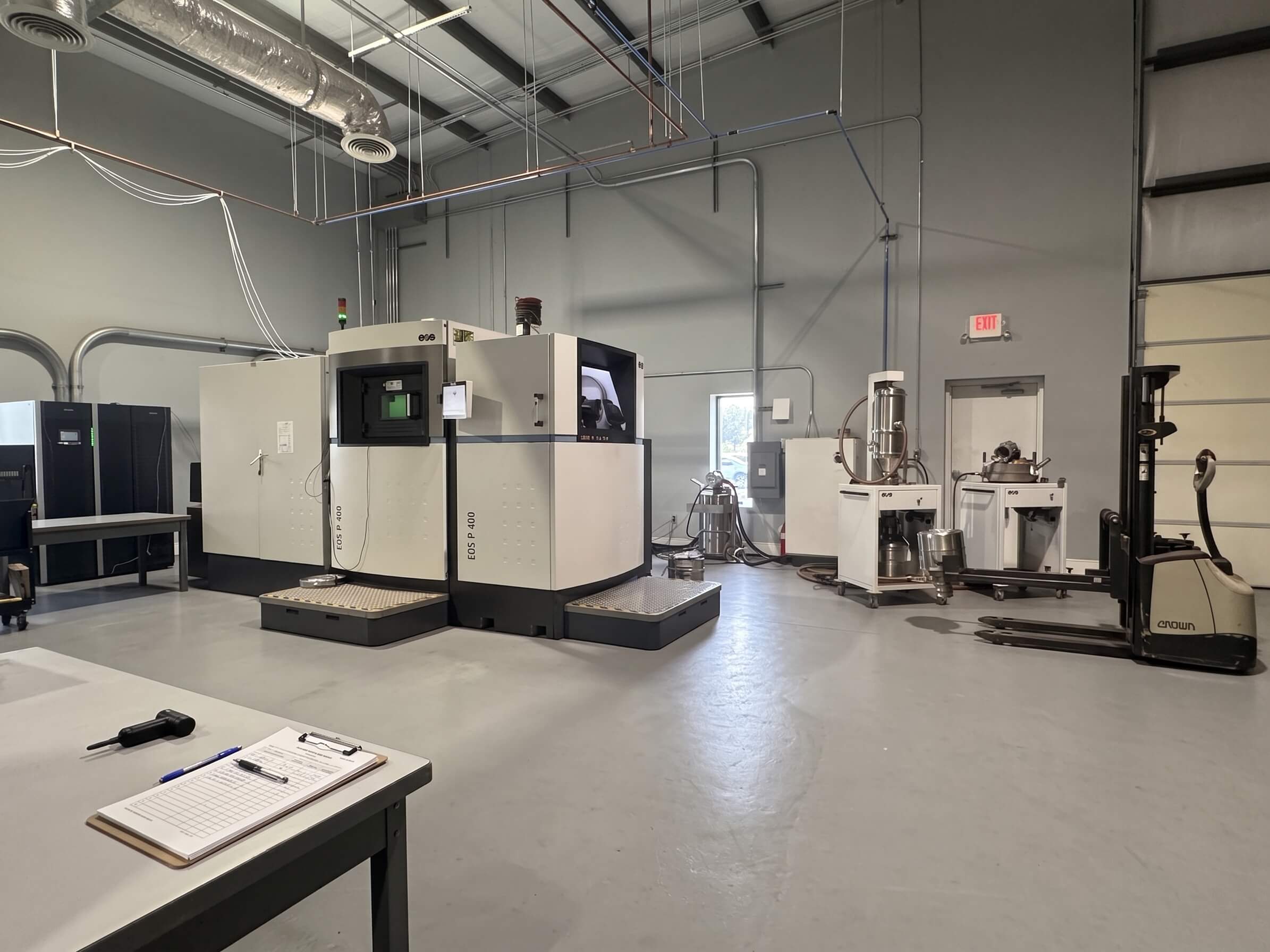
The EOS M 400 we run is the largest commercial metal additive platform in Alabama. Its 400 × 400 × 400 mm envelope builds a combustion chamber, a manifold or a full plate of brackets in one run, and it is the same machine class the propulsion primes use for their own hardware.
Most of the work on our floor is propulsion and turbomachinery hardware for aerospace and defense, with pilot series parts for medical and automotive programs alongside it.
Rapid manufacturing with metal 3D printing skips the pattern, the mould and the fixture. A design change is a new file, not a new tool, which is why development programs use it to iterate flight hardware in weeks. The same run that makes one prototype makes the pilot series: nest more parts on the plate and the process does not change.
We run the materials our customers actually fly, and we know how each one behaves in the build.
IN718
A nickel superalloy that keeps its strength and creep resistance where aluminium and steel give up. The default for turbine, manifold and structural hardware that runs hot.
Inconel 718 3D printingGRCop-42
A copper chromium niobium alloy developed by NASA. It moves heat like copper while holding strength past 700 °C, which is why it lines regeneratively cooled combustion chambers.
GRCop-42 3D printingTypical values for laser powder bed fusion on our platform. Program allowables come from your own coupons.
| Process | Laser powder bed fusion (LPBF), also called SLM or DMLS |
|---|---|
| Platform | EOS M 400, single 1 kW ytterbium fibre laser, argon atmosphere |
| Build envelope | 400 × 400 × 400 mm (15.7 × 15.7 × 15.7 in) |
| Layer thickness | 40 µm typical; thicker parameter sets where the part allows |
| Laser spot | Approximately 90 µm focus diameter |
| Materials | Inconel 718 (UNS N07718), GRCop-42 (Cu-Cr-Nb). Other alloys on request, subject to volume |
| Typical as built tolerance | ±0.1 to 0.2 mm on small features, plus a length dependent allowance. Tighter callouts by post machining |
| As built surface | Ra roughly 6 to 12 µm on vertical and upward faces; rougher on downward facing surfaces. Blasting, tumbling and chemical polishing available |
| Minimum wall | 0.5 mm supported; 1 mm recommended for structural walls |
| Post processing | Stress relief, plate removal, support removal, HIP, solution and age, machining, finishing |
| File formats | STEP preferred. Parasolid, IGES and STL accepted |
| Lead time | Quoted with the job. Ask for a date and we give you one we can hold |
Five moves. You hear from an engineer at every one of them, not a portal.
Send a STEP file and a material. You get pricing, a suggested orientation and an honest read on whether the geometry will build.
We flag overhangs, trapped powder and thin walls that will not survive, then propose the fix.
Fused layer by layer on the M 400 under argon, monitored through the run, with witness coupons on the plate when required.
Stress relief, plate removal, supports off, then HIP, heat treatment, machining and surface work to your callout.
Dimensional checks, material certs and build documentation travel with the parts.
If you are comparing metal 3D printing companies, the differences that matter are rarely on the price sheet.
A service bureau that builds metal parts from your CAD data on industrial additive machines, rather than selling you a printer. At AME that means laser powder bed fusion on an EOS M 400 in Inconel 718 and GRCop-42, with design review, post processing and inspection included in the job.
It depends on build height, part volume, supports, alloy and finishing. Small simple parts start in the low hundreds of dollars; large or complex Inconel and copper alloy builds run into the thousands. Our cost guide walks through the drivers, and a quote from us is free.
As built, typically ±0.1 to 0.2 mm on small features, with an additional allowance on longer dimensions. Where a drawing calls for tighter, we print with machining stock and finish the feature to size.
STEP is best. Parasolid, IGES and STL also work. Include a drawing or a note for critical dimensions, tolerances, surface finish and any heat treatment or testing the program requires.
No. We ship nationwide and most of our customers are outside Alabama. Being in Huntsville means we are next to NASA Marshall and Redstone Arsenal, and local customers can pick up at the shop.
One part through pilot series. A single plate on the M 400 can carry one large component or dozens of small ones, and repeat runs use the same locked parameters.
Yes. Most of our work is under NDA and we are used to program specific handling requirements. Tell us what the job needs when you send it.
The process families, the standards, and where laser powder bed fusion fits.
ProcessHow the machine works, the design rules, and LPBF next to powder metallurgy.
MaterialComposition, properties, heat treatment and ASTM F3055.
MaterialNASA’s copper alloy for chamber liners and injectors.
PricingSix cost drivers, typical ranges, and how to bring the number down.
LocationNext to Redstone Arsenal and Marshall. Visit the shop.
Request a quote
Pricing and an honest read on the geometry, from an engineer. Call the shop or send the request and we will pick it up from there.